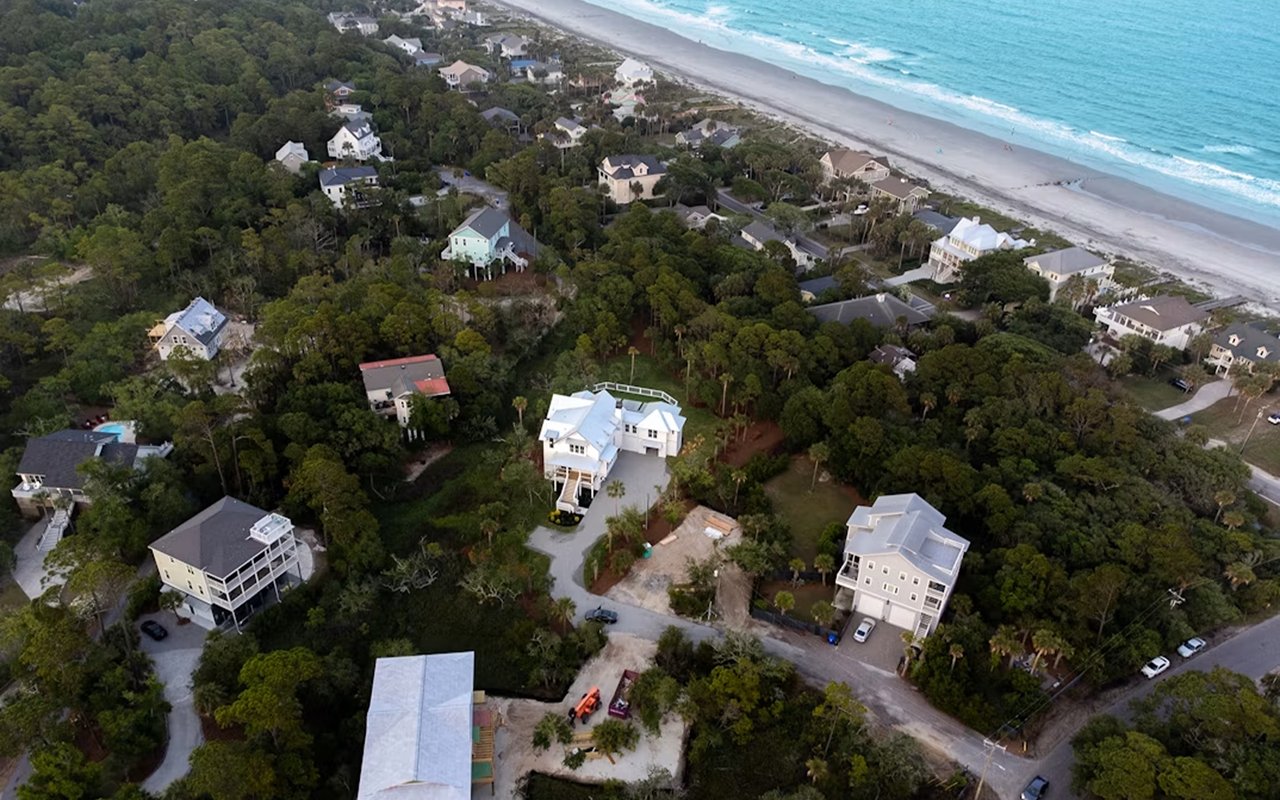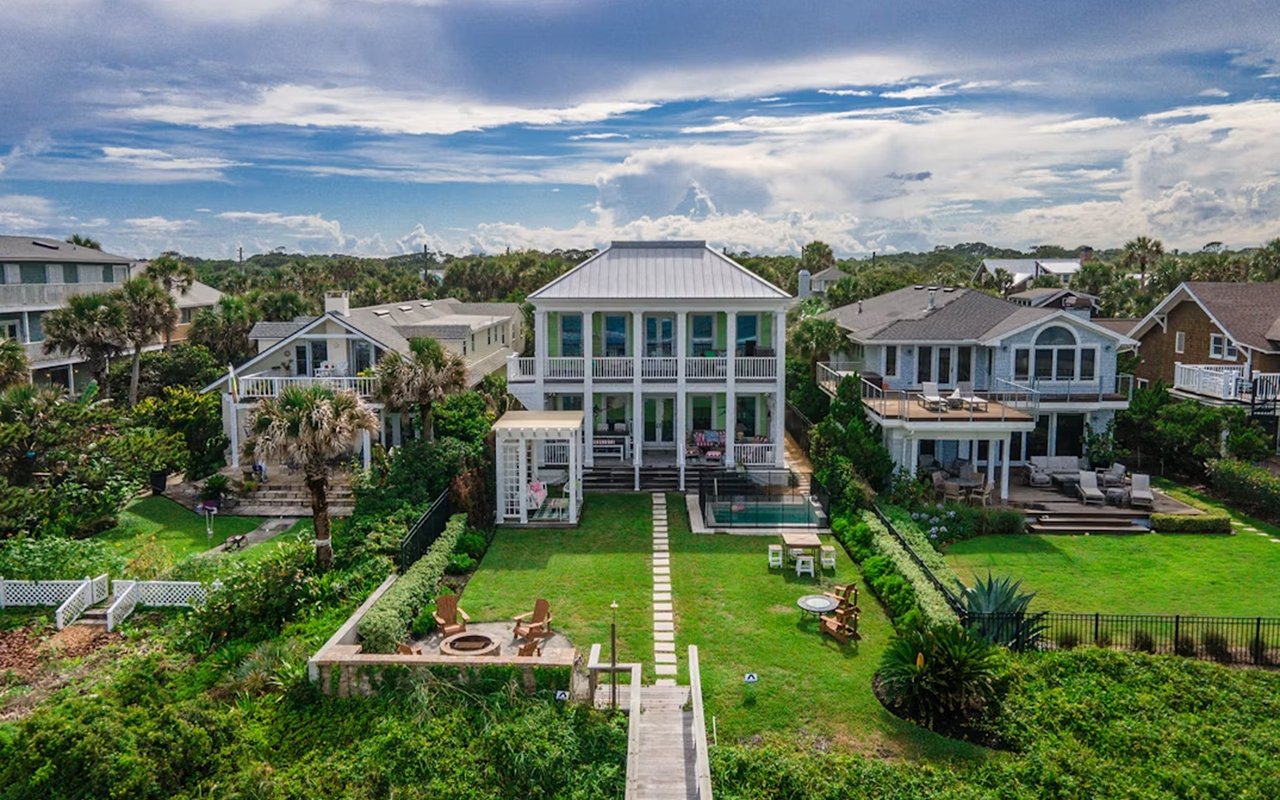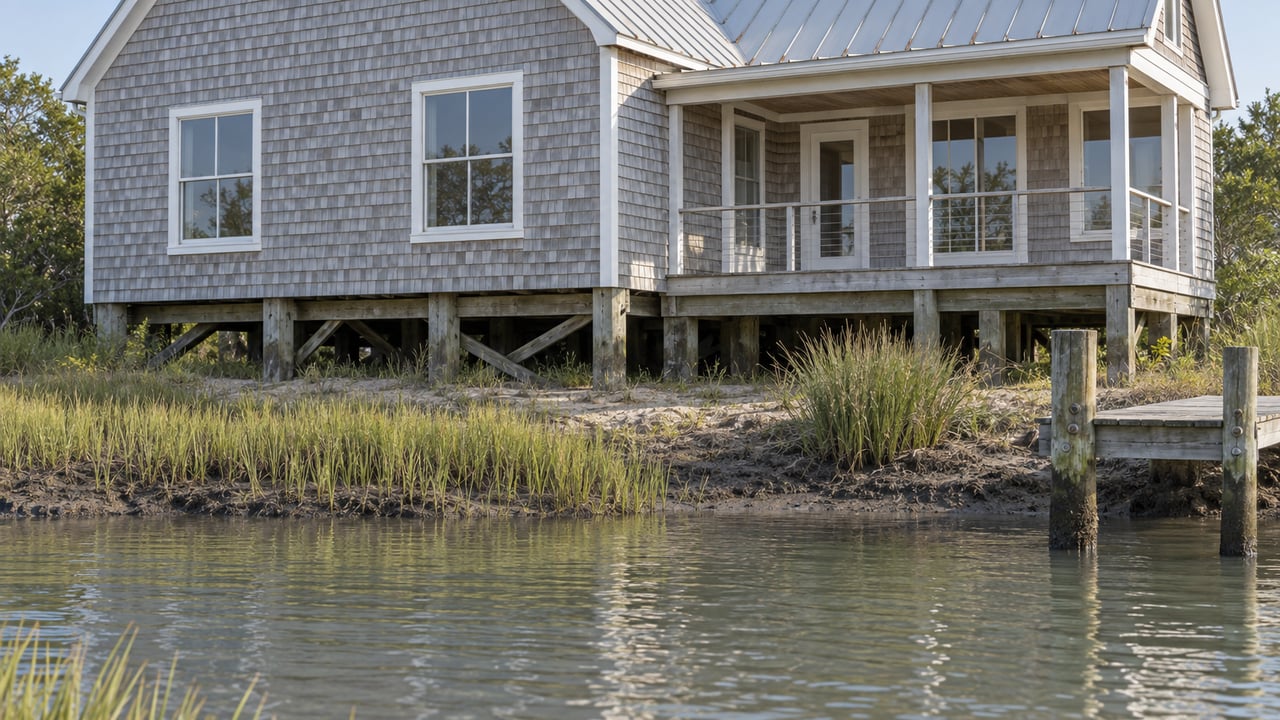
Two listings go up on the same week in the same price range, both tagged waterfront, both showing a dock in the hero photo. A buyer touring both back to back would be forgiven for treating them as interchangeable. At low tide, they are not. One dock still floats a boat. The other sits over a few feet of exposed mud until the water comes back.
That difference rarely shows up in a listing description. It shows up on a walk-through scheduled for the wrong hour of the day, or worse, after closing, when a boat that fit the marina photo doesn't fit the actual water.
Three products, one word
Oak Island's waterfront inventory splits into three distinct categories that get marketed under the same label. True Intracoastal Waterway frontage, found along Yacht Drive East and Yacht Drive West, sits on deep water that stays navigable regardless of tide. Davis Canal frontage, concentrated in the Long Beach section of the island, runs through a tidal cut that connects to the ICW but behaves differently along its own length. Interior and mainland-side lots, meanwhile, carry no water access at all and compete on a different axis entirely: how close they sit to a public beach crossing.
A median sale price for Oak Island as a whole sat at roughly $690,000 in early 2026, essentially flat year over year, with homes averaging around 153 days on market and selling near 97 percent of list price. That single figure is doing a lot of quiet work. It's an average of three products with different physical realities and different buyer intentions, blended into one number that tells a shopper almost nothing about which kind of water they're actually being offered.
The canal isn't one thing
Davis Canal is where the blending gets most misleading. Some stretches of it, particularly near where it opens into the ICW, genuinely qualify as deep water. A current listing along that stretch describes half an acre of deep-water Davis Canal frontage a few streets from the bridge, with a private pier, dock, and boat lift built for real boating.
Other stretches of the same canal run shallow enough that at least one vacation rental on Davis Canal warns its own guests directly: at low tide the water can drop to two or three feet, limiting dock use to small craft like kayaks, canoes, and jon boats under 14 feet. Another rental on the same canal describes it as navigable at low tide, which is true in the narrow sense that water remains, just not necessarily enough of it for anything larger than a paddle craft.
Both descriptions can be accurate at once, because they describe different points along the same waterway. That's the part a listing photo can't communicate. "Davis Canal frontage" is not a single depth or a single boating experience. It's a name attached to a variable, and the only way to know which version a specific dock delivers is to check it at low tide before writing an offer, not after.
Why the price bands overlap anyway
Because the label doesn't distinguish between these realities, pricing often doesn't either, at least not cleanly. Oceanfront homes on Oak Island generally start around $800,000 and run past $2.5 million for larger, updated properties with direct beach access. Canal and ICW-front homes with private docks typically land in the $500,000 to $1.2 million range, though premier canal-front properties with true deep-water dock access can push into oceanfront territory, sometimes exceeding $1.5 million. Interior homes a few blocks from the water, without any frontage at all, generally run $300,000 to $800,000 depending on size, age, and proximity to a public beach access point.
That overlap between the top of the interior tier and the bottom of the waterfront tier, and again between the top of canal-front and the bottom of oceanfront, means price alone won't tell a buyer which product they're comparing. A $650,000 canal-front listing near the ICW mouth and a $650,000 canal-front listing three blocks up the same waterway can represent two very different boating outcomes for the same money.
The walkability premium that has nothing to do with water
A second, separate value axis runs through Oak Island pricing and it has nothing to do with docks. The island's mainland side and its oceanside are split by a tidal creek, and only a handful of crossings connect them on foot or by golf cart: Middleton Avenue, the walkway near SE 9th Street, and another at SE 20th Street. Homes positioned near these specific crossings carry a convenience premium for beach walkability that shows up independent of whether the home touches water at all.
This matters because a buyer evaluating "waterfront versus not" is often really comparing two different questions at once. Is this home on navigable water, and is this home an easy walk to the beach. A non-waterfront interior home two blocks from the Middleton crossing can out-price a canal-front home eight blocks from any beach access, because the market is pricing convenience and dock access on separate scales that don't always move together.
What the insurance file sees that the photo doesn't
The cost gap between two waterfront-labeled homes rarely stops at the purchase price. Flood insurance on Oak Island depends heavily on a document most buyers never see during a showing: the Elevation Certificate, which records how a home's first finished floor compares to its Base Flood Elevation. Homes built on pilings tend to sit well above that line and often carry meaningfully lower flood premiums than slab-on-grade construction at or near it, even on the identical lot.
Oak Island properties commonly fall into flood zones AE, VE, or X, each carrying different requirements. Zone X isn't federally required to carry flood coverage for most mortgages, though a substantial share of national flood claims, close to 40 percent, come from properties in zones like it, which is worth weighing even where a lender doesn't mandate the policy. The Town of Oak Island's flood information page and FEMA's own map service center are both useful starting points before assuming a home's insurance cost from its neighborhood alone.
Two homes on the same block, same price, same dock type, can carry different annual insurance costs simply based on foundation height and whether an Elevation Certificate exists on file. Asking a seller for that certificate early is one of the more useful, least glamorous steps in comparing waterfront listings that otherwise look identical on paper.
Before writing an offer
A short list of what to verify, rather than assume, when a listing says waterfront:
- Ask specifically which waterway the dock sits on and request the depth at low tide, not just at high tide when photos are typically taken
- If the frontage is Davis Canal, ask where along the canal the property sits relative to its opening into the ICW
- Request the Elevation Certificate if one exists, and note the foundation type, pilings or slab
- Confirm the flood zone designation directly rather than relying on general neighborhood reputation
- If beach walkability matters as much as water access, check the distance to the nearest named crossing rather than assuming all non-oceanfront homes are equally far from the sand
None of this requires distrust of a listing. It requires treating "waterfront" as a starting point for questions rather than a finished description.
Frequently asked questions
Is Davis Canal frontage still worth paying for if part of it runs shallow? It depends entirely on intended use. A dock that only accommodates kayaks or a small jon boat at low tide still offers real value for fishing, paddling, and water access, just not the same value as a slip that holds a larger boat year round. The two shouldn't be priced identically, and a buyer comparing them should ask what kind of boating they actually plan to do before assuming deep water where none exists.
Can a home in Zone X still flood? Yes. Zone X sits outside the federally mapped high-risk area, which is why lenders typically don't require flood insurance there, but it isn't a guarantee against water. A meaningful share of flood claims nationally come from Zone X properties, which is one reason some buyers choose a policy there even without a mandate.
Does proximity to a beach crossing matter more than water frontage? It depends on the buyer's priorities rather than a universal ranking. Some buyers value dock access above all else. Others prioritize an easy walk to the sand over any water frontage. The Oak Island market prices both, separately, which means a buyer should be clear on which one matters more before letting price alone guide the comparison.
If you're weighing waterfront options on Oak Island and want a second look at what a specific dock, canal segment, or crossing actually offers before you write an offer, reach out to the Suzanne O'Bryant Group.